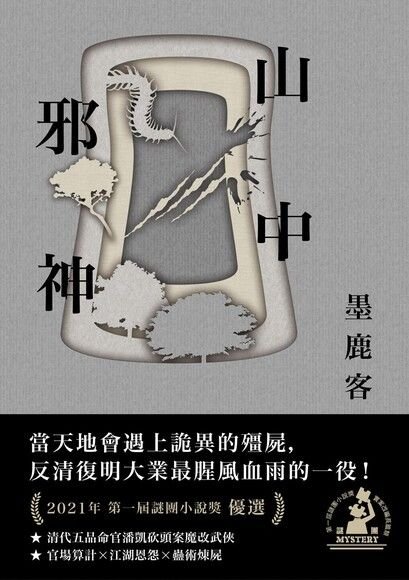
山中邪神

山中邪神

shān zhōng xié shén
Details
Author 墨鹿客 · Mo Lu-ke
Language Traditional Chinese · Taiwan
Format Novel
Published 2023
Pages 320
Read 2026-09-04 → 2026-09-16
Finished
Awards

Review

山中邪神 was fantastic!!! I’m so grateful I got to read it, and I’m really happy I discovered the 謎團小說獎 by The Office of Historical Suspense Investigation & Research, otherwise I would probably never have found this book.

山中邪神 is one of the three works that won the first edition of the contest. Rules are that the fiction must be inspired by a real criminal case that took place in Taiwan, and this novel’s inspiration is the murder of a governor in Taiwan during the Qing dynasty.

This is mostly a wuxia novel with a historical background though it also adds magical elements. It blends genres like wuxia, mystery and horror, and I personally enjoyed every aspect of the novel.

Political intrigues and schemes are an important part of the novel, so it was a real struggle at first to work my way through historical concepts and vocabulary, but the payoff was huge. The novel depicts a complex web of influence and struggle for power, all closely linked to the situation of Taiwan at the time (1786). Qing officials, Tiandihui members, factions and internal conflict, powerful and influent local families… some fight for political and economical control over Taiwan, over fight for revenge, over pursued what they think is the right path…

The result was a suspenseful, fast paced plot with some epic battles, ingenious manoeuvres and schemes, and mysterious entities who leave a trail of death wherever they go (some parts were quite gory, as a fan of horror, I loved it!!).

The plot and the setting are great, but the characters are equally good. It’s crazy because we don’t get to spend that much time with any of them, there aren’t a lot of introspection or reflexions on the characters, yet it feels like I know them all very well. The main cast was very interesting, our protagonist Lee Hsiu-man was very likeable, but I personally really enjoyed characters that have inner struggles like Chao I-shan, who might be my favourite character.

I don’t know what to say more, this book was fantastic, I loved it more than I can say. And it was a real struggle to read, It took me 26 hours to read (I saw the stats on Readmoo), which is double the time a book of this length usually takes me to complete. This is how much I had to pause to look things up, re-read passages, and how slow I was overall. Despite the language difficulties, I had a lot of fun reading it. Actually, it’s been a while since I got so passionate about a story.


Updates

100%

I can’t believe I finished it! When I finished chapter 11, I thought I might as well just continue. It’s crazy how much easier the book has become, the first chapters were so so hard, then it got much easier with some occasional difficult passages that I needed to study, then I was just able to read without looking up words anymore. There’s a lot of recurring vocabulary!

Yeah, this is going to be my favourite book of the year for sure!

第十一章 長夜將盡
90%

What?! How??!!?

第十章 青紅皂白
82%

That was an incredible chapter! The last lines were so beautiful and impactful!!

第十章 青紅皂白
75%

As expected, I only had time to read half of chapter 10, but this part had such an important episode! I really really love this book.

And 3/4 into it too! I wonder if I can finish it this week?

第九章 窟藏百骸
70%

Daily chapter done! this one was a short one, perfect for today given that I’m very tired…

第八章 部落之殤
64%

So many unexpected things happened!!

第七章 藥屍活傀
59%

Chapter 7 was incredible!!!! I could not put it down! I didn’t plan on finishing the chapter today, but it was so suspenseful, this book is amazing!!

It has become so much easier to read too. Efforts are paying off. Studying passages in depth, adding words to the flashcards and making exercises based on the paragraphs I hadn’t understood when reading.

第六章 靈藥現跡
48%

Chapter 6 finished! And quasi halfway through!

I was certain that 百年の時効 by Miki Fushio would be my favourite book read in 2026, but if this novel continues like this, it’s going to be this one!

第五章 兔死狗烹
40%

Chapter 5 finished today! 40% into the book, and now I start finding it easier. There are some recurring chengyu too that I just learnt in previous chapters, so that feels rewarding!

第四章 十面埋伏
31%

The second half of chapter 4 was quite hard to read, but I got there.
The plot is so good, I really wasn’t expecting so many people to die!

第四章 十面埋伏
25%

I didn’t go very far in chapter 4, but overall I feel that my reading pace has increased for this novel, and it feels easier now. I’m also 1/4 into the book now. Feeling proud of myself! And the plot is so suspenseful: conspiracies, betrayal, fight for power, influence and money… I love it!

第三章 引君入彀
22%

Chapter 3 was much much easier to read!

第二章 暗流湧動
18%

I finished chapter 2, this one was even more difficult than chapter 1!

第二章 暗流湧動
13%

My goal was to finish chapter 2 today, but I haven’t even read half of it. Again, it has quite difficult passages, so I’m taking my time. I also decided to add unknown words to my flashcards, so I’m spending more time studying vocabulary than actually reading. I’m thinking that studying this book is a good opportunity to open the doors of more historical and wuxia novels to read in the future.

第一章 城中詭事
10%

Finished chapter 1, and even though it necessitated a lot of looking up words and research, I understood it well in the end. I actually find it very exciting and motivating to have a challenging book that I absolutely want to understand. I think that most of the time, when we’re struggling to understand a text, the reason we give up is not that the text was too difficult or our level too low, but that our desire to understand this particular text was just not big enough to justify the effort.

Anyway, chapter 1 was fantastic, I love wuxia a lot, I really should read more of this genre.

Also now that I know the setting and more or less the main actors and tensions of the plot, I think it’s going to be easier from now on.

第一章 城中詭事
8%

I’ve been very distracted today and haven’t read as much as I wanted, so I did not finished chapter 1, but I loved the story!! It blends several genres: wuxia with extreme martial arts, historical novel with political conspiracies and a mystery novel with strange occurrences, and also a bit of supernatural horror. It’s absolutely perfect,

The first two pages of chapter 1 were very difficult, but it gets much better afterwards, with some passages easier than others. Still it’s definitely a challenging read for me, but it’s not hard to the point where I’m tempted to give up. The plot is very intriguing too which helps, and it’s been a while that I wanted to read a wuxia novel, so that’s a plus too.

Now that I think of it, a lot has happened in the few pages I read so far. The pace is very fast, and it’s very suspenseful.

楔子一
2%

I only read the prologue, but the story looks so cool!! I loved the beginning!! I had to look up some words and persons/events, especially the very first pages, but I loved it. Feels more wuxia than mystery so far, but whichever it is, I’m here for it!

Hopefully the novel will become easier, because if it continues like this I’ll need the whole month to finish…

Characters

第九章 窟藏百骸
  • 劉義匡 liú yì kuāng Liu I-kuang
    Member of the White Crane Hall.
  • 盛益斗 shèng yì dǒu Sheng I-tou
    Member of the White Crane Hall.
  • 孫超 sūn chāo Sun Chao
    A member of the Tiandihui headquarters who holds the title of 護劍真武 but is also called 白雲長. Long-time acquaintance of Tsai Chung-ching.
  • 徐奉年 xú fèng nián Hsu Feng-nien
    A young man and third-generation disciple of the Tiandihui headquarters holding the title 'Sword-Bearer' (持劍), Sun Chao’s disciple.
  • 肖詩奇 xiào shī qí Hsiao Shih-chi
    A tall, thin elderly man and second-generation disciple of the Tiandihui headquarters known as 'Glass Light' (琉璃光), serving as the Medicine Hall Elder (藥堂長老) with superb medical skills.
  • 錢進 qián jìn Chien Chin
    A middleman in the medicinal herbs trade, hired by Chin Hsi and serves as interpret.
  • 金喜 jīn xǐ Chin Hsi
    A martial enforcer (referred to as a 'tiger general') in the disciplinary/enforcement hall (刑堂) who is looking for the 蟠龍草.
  • 巴燕 bā yàn Pa-yen
    The man who knows about 蟠龍草.
  • 塔木 Tǎmù Tamu
    Gathers rare medicinal herbs specifically for Xuanjing Tang, knows about the 蟠龍草.
  • 黃燦 huáng càn Huang Tsan
    A collateral member of the Huang family and the youngest escort leader of Kaishan Hall who secretly operates as a highway bandit, assassin, and henchman.
  • 徐奇 xú qí Hsu Chi
    Member of Chen Pao-sheng's squad.
  • 馬昌 mǎ chāng Ma Chang
    Member of Chen Pao-sheng's squad.
  • 陳通 chén tōng Chen Tung
    The heavy-bearded middle-aged martial artist known as the 'Eight-Armed Ape' (八臂猿) from the Shenyuan Sect of the southeastern coast.
  • 孫磐 sūn pán Sun Pan
    The shaved-headed young martial artist known as 'Little Vajra' (小金剛) from the northern Juling Sect.
  • 牧榮 mù róng Mu Jung
    The refined gentleman known as 'Cloud Sword' (雲劍), an outcast disciple of the Kongtong Sect who leads Chen Tong and Sun Pan.
  • 雲曦子 yún xī zǐ Yun-hsi-tzu
    The master mentioned as having taught dual-sword martial arts to Mu Rong.
  • 余清順 yú qīng shùn Yu Ching-shun
    Indigenous disciple/adopted son of Li Jingyuan
  • 王蒼庭 wáng cāng tíng Wang Tsang-ting
    Known as the 'White Lotus Medicine King' and nicknamed 'Du Sou' (Poison Elder), a master of poison and medicine and leader of multiple White Lotus uprisings who disappeared for over a decade.
  • 胡嶽 hú yuè Hu Yueh
    Current Grand Master (總舵主) of the Tiandihui.
  • 謝君實 xiè jūn shí Hsieh Chun-shih
    Military strategist/advisor (軍師) of the Xuanshui Hall.
  • 蔡忠清 cài zhōng qīng Tsai Chung-ching
    Currently Hall master (堂主) of the Xuanshui Hall.
  • 李靖元 lǐ jìngyuán Li Jingyuan
    The hall master of the Qinglian Hall, one of the two Tiandihui branches in Taiwan.
  • 林爽文 lín shuǎngwén Lin Shuangwen
    The hall master of the Baihe Hall, one of the two Tiandihui branches in Taiwan.
  • 趙一山 zhào yī shān Chao I-shan
    From the Qinglian Hall, direct disciple of Wu Feng.
  • 程 chéng Cheng
    The former Sub-Prefect (before Pan Kai) who previously received favours and bribes from the merchants.
  • 王寶方 wáng bǎo fāng Wang Pao-fang
    A former interpreter who used to profit during the tenure of Official Cheng but was dismissed as soon as Pan Kai took office.
  • 潘凱 pān kǎi Pan Kai
    Sub-prefect (同知) of Tamsui Subprefecture (淡水廳) stationed in Zhuqian City (竹塹城).
  • 陳寶昇 chén bǎo shēng Chen Pao-sheng
    The head constable (捕頭) on duty at the magistrate's yamen.
  • 黃嘉 huáng jiā Huang Chia
    Young labourer living in Lunzi zhuang who came to the authorities to report the incident
  • 柴隆 chái lóng Chai Lung
    The elder brother living near Huang Chia's courtyard in Lunzi zhuang.
  • 黃平 huáng píng Huang Ping
    The younger brother living with Chai Lung near Huang Chia's residence in Lunzi zhuang.
  • 葉 yè Yeh
    Head of the hired escort guards and martial arts instructors paid by wealthy families to pose as traveling merchants and ambush the Mayuan Village bandits.
  • 胡鐵牛 hú tiě niú Hu Tieh-niu
    A former tenant farmer from one of the escort's village who joined the Yellow Sand Gang as a bandit.
  • 蔡忠清 cài zhōng qīng Tsai Chung-ching
    A young man and Tiandihui member who attempts to persuade his sworn elder brother to flee with him before government troops attack again.
  • 秀兒 xiù ěr Hsiu-erh
    Young child of Tsai Chung-ching's sworn brother, himself the only surviving direct descendant of Zheng Chenggong. He never got involved in the Tiandihui and lived hidden but still got entangled in the society internal factional power disputes.
  • 鄭亦勛 zhèng yì xūn Cheng I-hsun
    A high-ranking leader of the Tiandihui and descendant of Zheng Chenggong who slit his own throat in the ancestral hall when Chen Family Village was massacred. Cai Zhongqing’s sworn brother’s father.
  • 陳 chén Chen
    Seized power as the new Supreme Chief (總舵主) after the deaths of Zheng Yixun and the Old Strategist (referred to as 老軍師), and initiated a purge against their faction.
  • 李秀滿 lǐ xiù mǎn Lee Hsiu-man
    Full name of the child, named Li after his mother, as was his father’s wish.
  • 胡嶽 hú yuè Hu Yueh
    Member of the Tiandihui and acquainted with Cai Zhongqing. One of the three members who came for Xiuman and the jade pendant. Secretly agrees with Zhongqing.
  • 武峰 wǔ fēng Wu Feng
    One of the members confronting Tsai Chung-ching, the most vehement of the three to bring the child back to Chen.
  • 謝君實 xiè jūn shí Hsieh Chun-shih
    One of the three member of the Tiandihui who strikes a deal with Cai Zhongqing, planning the child’s future mission.

Quotes

第五章 兔死狗烹

——已經沒有什麼可以失去的,心中只剩下復仇的念頭,復仇的火焰越是燃燒,李秀滿的心便如同灰燼般冰冷。

Vocabulary

第六章 靈藥現跡
WordReadingDefinition
拔高 bá gāo to shoot up; to rise abruptly
罡風 gāng fēng fierce wind generated by inner energy; astral wind
五嶽倒蓋 wǔ yuè dào gài as if the Five Sacred Mountains were crashing down

Martial art idioms and expressions are also quite the challenge. I’m adding them to my flashcards with notes that explain them. 五嶽倒蓋 was used to describe a downward palm strike. The palm itself was said to be as large as a 蒲扇 (pú shàn cattail-leaf fan)

第二章 暗流湧動
WordReadingDefinition
丹方 dān fāng alchemy formula; traditional elixir recipe
教亂 jiào luàn sectarian rebellion; religious uprising
暗衛 àn wèi covert guards; secret bodyguards; shadow operatives
布政使 bù zhèng shǐ Provincial Administration Commissioner
第一章 城中詭事
WordReadingDefinition
同知 tóng zhī sub-prefect (Qing official title)
師爺 shī ye private secretary / magistrate's aide
捕頭 bǔ tóu constable chief / head bailiff
流水官 liú shuǐ guān transient official / rotating magistrate
豪紳 háo shēn local gentry / powerful wealthy elites
差吏 chāi lì petty yamen runner / local clerk
樁 zhuāng mole / plant / embedded agent
穿小鞋 chuān xiǎo xié to secretly sabotage / to give someone a hard time
人情世故 rén qíng shì gù social etiquette / ways of the world / interpersonal relations
土地清丈 tǔ dì qīng zhàng cadastral land survey; land remeasuring
漢番邊界 hàn fān biān jiè Han-indigenous boundary; border between Han settlers and indigenous peoples
舉措 jǔ cuò measures; initiatives; administrative actions
積弊 jī bì long-accumulated abuses; long-standing malpractices
整頓吏治 zhěng dùn lì zhì to clean up officialdom; to reform civil administration
迎合 yíng hé to pander to; to fawn on; to cater to
扣克 kòu kè to embezzle; to withhold or dock (wages)
薪餉 xīn xiǎng salary; pay; soldier's/clerk's stipend
累差 lěi chāi burdensome official duties; thankless errands; exhausting tasks
仵作 wǔ zuò coroner
挑夫 tiāo fū porter / carrier
捕快 bǔ kuài constable / bailiff
慫貨 sǒng huò coward; wimp; pushover
請纓 qǐng yīng to volunteer for a difficult assignment; to take the initiative to take on a task
嫡系 dí xì direct lineage; direct descendant / core family member
鏢師 biāo shī armed escort; bodyguard / convoy guard
招兵買馬 zhāo bīng mǎi mǎ to recruit men and buy horses; to raise an army; to gather manpower
落草為寇 luò cǎo wéi kòu to take to the hills and become an outlaw; to turn to banditry
格殺勿論 gé shā wù lùn to kill on sight without mercy; summary execution permitted
佃農 diàn nóng tenant farmer
惡吏 è lì corrupt minor officials; unscrupulous functionaries
落草為寇 luò cǎo wéi kòu to become a bandit; to take to the greenwood
世家 shì jiā prominent clan; aristocratic family; influential lineage
楔子一
WordReadingDefinition
總舵主 zǒng duò zhǔ Supreme leader (of a secret society or branch network)
堂口 táng kǒu branch / lodge of a secret society or triad
結拜 jié bài sworn (brotherhood); to become sworn brothers

Glossary

第四章 十面埋伏
  • Place 林子口隘 lín zǐ kǒu ài Linzikou Pass
    The mountain pass that serves as an ambush location on the trail leading towards Zhuqian.
  • Organisation 開山堂 kāi shān táng Kaishan tang
    An armed escort agency (鏢局, biāojú).
  • Organisation 神轅門 shén yuán mén Shengyuan Sect
    A regional martial arts sect located along the southeastern coast of China.
  • Organisation 巨靈門 jù líng mén Juling Sect
    A northern martial arts sect.
  • Organisation 崆峒派 kōng tóng pài Kongtong Sect
    A prestigious, traditional martial arts school based in the Kongtong Mountains. Within the fictional hierarchy of martial arts, it is considered one of the elite, orthodox sects officially recognized in historical or state genealogical records, giving its trained members—even expelled disciples—high standing relative to common underworld figures.
第二章 暗流湧動
  • Organisation 玄水堂 xuán shuǐ táng Xuan Shui Hall
    A regional lodge of the Tiandihui based in Fujian province.
  • Person 三寶太監 sān bǎo tài jiàn San-pao Tai-chien
    Historical figure Zheng He (Sanbao Eunuch), famous 15th-century Chinese admiral and explorer during the Ming Dynasty.
  • Person 國姓爺 guó xìng yé Koxinga
    Koxinga (Zheng Chenggong), the historical figure and founder whose direct descendants hold significant authority and command over a secret guard within the context of the Tiandihui.
  • Place 貓裡社 māo lǐ shè Maoli Settlement (Bari Settlement)
    A historical settlement of the indigenous Taokas people, located in the area of modern-day Miaoli City in western Taiwan.
  • Place 兩廣 liǎng guǎng Liangguang
    A historical region encompassing the provinces of Guangdong and Guangxi in southern China, often governed under a single governor-general during the Qing dynasty.
  • Place 浙閩 zhè mǐn Zhe-Min (Zhejiang and Fujian)
    A combined geographic reference to the provinces of Zhejiang and Fujian in southeastern China.
  • Place 閩浙 mǐn zhè Min-Zhe (Fujian and Zhejiang)
    A combined geographic designation for Fujian and Zhejiang provinces in southeastern China, overseen jointly by the Viceroy of Min-Zhe during the Qing dynasty. It is a real place. Also 浙閩.
  • Person 雅德 yǎ dé Ya-te
    A high Qing official, did become the viceroy of Minzhe.
  • Person 富勒渾 fù lè hún Fulehun
    A high Qing official whose impending transfer to Viceroy of Liangguang leaves the Viceroy of Min-Zhe post in play.
  • Place 璿景堂 xuán jǐng táng Xuanjing Tang
    The largest Chinese traditional pharmacy in Zhuqian City, operated nominally by Boss Chen but actually controlled by Wang Baofang.
  • Person 伍拉納 wǔ lā nà Wu-la-na
    Provincial Administration Commissioner (布政使) also coveting the post of Viceroy of Minzhe
第一章 城中詭事
  • Place 淡水廳 dàn shuǐ tīng Danshui Subprefecture
    A historical administrative division established during the Qing dynasty, governing northern Taiwan.
  • Place 竹塹城 zhú qiàn chéng Zhuqian City
    A historical walled settlement located in northern Taiwan, which served as the seat of Danshui Subprefecture. Today, it corresponds to Hsinchu City.
  • Concept 淡水撫民同知 dàn shuǐ fǔ mín tóng zhī Sub-prefect for Pacifying the People of Danshui
    A specific Qing dynasty official title for the Sub-prefect of Danshui Subprefecture in northern Taiwan, tasked with local civil administration and managing indigenous-settler affairs.
  • Place 崙子莊 lún zǐ zhuāng Lunzi Village
    Village located outside the city walls where the incident took place.
  • Place 石子林莊 shí zǐ lín zhuāng Shizilin Village
    Village situated southeast outside the walls of Zhuqian City.
  • Organisation 青蓮堂 qīng lián táng Qinglian Lodge (Green Lotus Hall)
    Historically the Fifth Lodge (or House) among the five major constituent lodges of the Tiandihui (Heaven and Earth Society), traditionally associated with members operating in Guangdong and Guangxi. In the novel, it’s one of the two lodges based in Taiwan.
  • Place 後壠港 hòu lǒng gǎng Houlong Port
    A real historical port located in present-day Houlong Township, Miaoli County, Taiwan. It served as a significant trading port along the western coast of Taiwan during the Qing dynasty era.
  • Organisation 白蓮教 bái lián jiào White Lotus Society
    A syncretic religious and political underground movement in imperial China that frequently led secret resistance societies and armed rebellions against ruling dynasties, such as the Qing.
  • Organisation 禁軍 jìn jūn Imperial Guard
    An imperial military institution responsible for guarding the imperial court, the palace, and the capital city in dynastic China.
  • Place 大里杙 dà lǐ yì Daliyi
    The historical name for modern-day Dali District in Taichung. In the Qing dynasty, it was a notorious hotbed for secret society activity, anti-government dissent, and the epicenter of major uprisings (such as the Lin Shuangwen Rebellion).
  • Organisation 白鶴堂 bái hè táng Baihe Hall
    The second lodge operating in Taiwan.
楔子一
  • Person 順治 shùn zhì Shun-chih
    Shunzhi Emperor of the Qing dynasty.
  • Person 鄭成功 zhèng chéng gōng Cheng Cheng-kung
    Historical military leader who resisted the Qing conquest of the Ming dynasty, captured Taiwan, and (according to legend) founded the Tiandihui (Heaven and Earth Society).
  • Person 陳近南 chén jìn nán Chen Chin-nan
    Military strategist and overall Grand Master (總舵主) of the Tiandihui who led the underground resistance movement to overthrow the Qing and restore the Ming.
  • Person 康熙 kāng xī K'ang-hsi
    The Kangxi Emperor of the Qing dynasty who succeeded Shunzhi.
  • Person 施琅 shī láng Shih Lang
    The Admiral of the Fujian Naval Fleet who led Qing troops to recover Taiwan in the 22nd year of the Kangxi era.
  • Person 乾隆 qián lóng Ch'ien-lung
    The Qianlong Emperor of the Qing dynasty.
  • Organisation 天地會 tiān dì huì Tiandihui (Heaven and Earth Society)
    Founded in the 1760s, the Tiandihui was first a mutual-aid fraternal organization among marginalized migrant workers, itinerant laborers, and small-time merchants. Overtime, the group adopted anti-Manchu political rhetoric under the slogan 反清復明. It will eventually lead to the 1786 Lin Shuangwen Rebellion under Qianlong’s reign. The legend claims that the society was founded by a Ming loyalist prince, Zheng Chenggong, as a secret, underground resistance network. But from what I understand, this belongs to folklore, and the society was initially started as a mutual-aid fraternal brotherhood for poor, displaced laborers rather than a political liberation army. The anti-Qing rhetoric was only adopted later, when facing brutal government crackdowns.
  • Organisation 鄭氏王朝 zhèng shì wáng cháo Zheng Dynasty (Kingdom of Tungning)
    The political regime and naval dynasty founded by Koxinga (Zheng Chenggong) on Taiwan, also known historically as the Kingdom of Tungning (1661–1683). It functioned as a loyalist Ming state opposing Qing authority before being conquered by Qing forces.