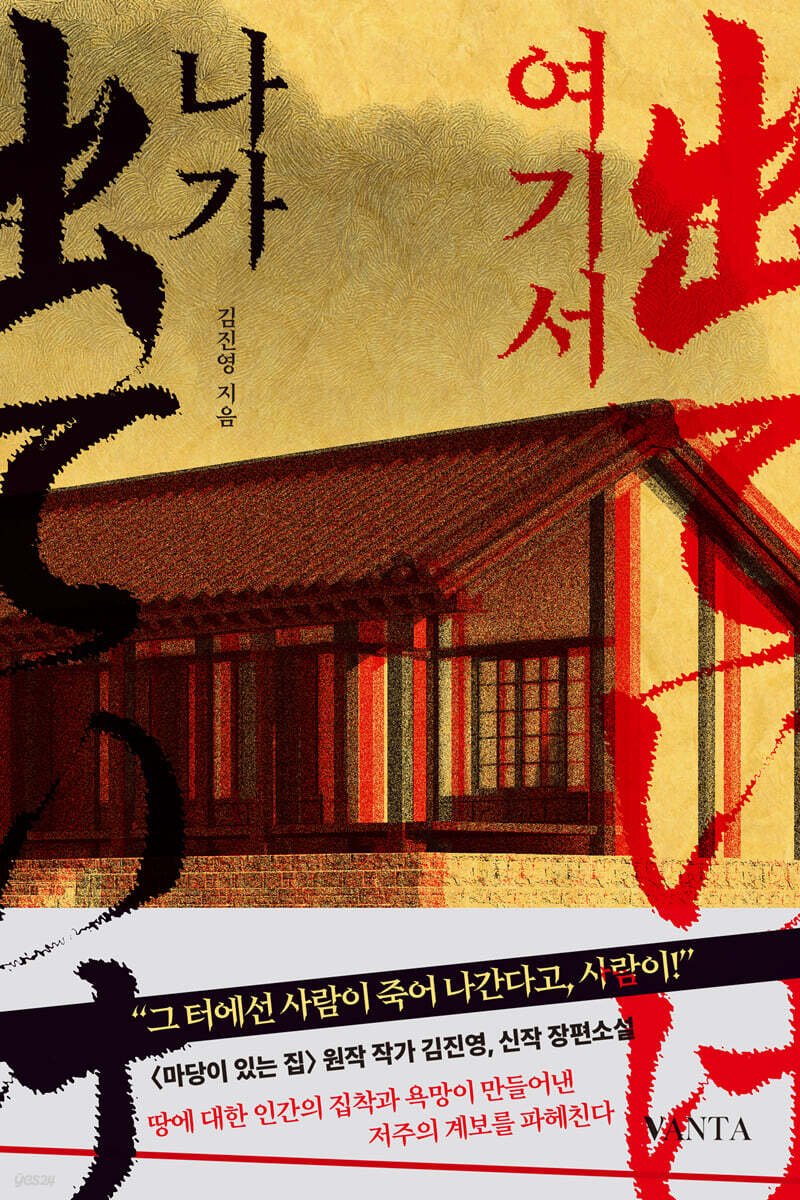
여기서 나가

여기서 나가

Author 김진영
Language Korean
Format Novel
Published 2026
Pages 336
Read 2026-09-27 → 2026-10-06
Finished

Review

I really love this novel! It’s really well written, the characters have a lot of depth and the story is suspenseful.

I especially loved the family dynamic (almost all the characters are from the same family), the generation gap between Sang-jo who values owning the family land and the younger generations who think in terms of investment, money and profit. It was also interesting to see how events affect Yu-hwa and Hyung-yong relationship, and overall I found all the characters really well written. I find that even without the main thread of the curse, just following the character as greed tear them apart was really great. And of course the mystery surrounding the land makes the novel even more engrossing.

The setting was also excellent, it made me want to visit Gunsan! Though it’s not a historical mystery, the origin of the plot starts during the Japanese Occupation period, which does give a historical flavour to the novel.

One of my favourite Korean novels read this year!


Updates

100%

Finished it!
Loved it!! :heart:

4장 침입자 侵入者
93%

The end of chapter 4 was so good!!
Only one chapter left, I’ll probably finish it this evening then.

4장 침입자 侵入者
86%

I’m tempted to just finish the chapter, but I need to open my other books too, so I’ll stop here for today. I’ll probably finish it tomorrow.

3장 유메야 ゆめや
64%

I was planning on reading a little bit of each novel today, but I ended up finishing chapter 3! It’s impossible to put down, I really really love this novel.

2장 기운 氣運
42%

Finished chapter 2! I really love stories were characters’ lives already feels like hell, even though the supernatural threat has not fully started yet. I really love the character of Yu-hwa, I feel that just the situation in which the family finds itself would make for a great plot, but of course, there’s more to the story and I’m also here for that!

This novel is really great in both establishing the characters’ positions and situation, their dynamics, conflicts and resentment and making us really care for them while giving a good foundation to the plot. As well as creating suspense with a mix of mystery and horror. So far it’s one of the best novels I’ve read this year.

2장 기운 氣運
33%

This book is really fantastic, characters are all so interesting and realistic, and we have a new point of view in chapter 2 as well, which makes things even more compelling. Their inner conflicts and worries are very relatable, and I really like how anchored in reality the story is while also hinting at supernatural elements.

The plot unfolds slowly but the tension is here, steadily growing.

I love every aspect of the book so far and I find it really well written.

1장 아귀 餓鬼
17%

I finished the first chapter. This book is so so well written, and so intriguing too. It’s much better than I expected, I don’t know I thought it would be basic haunted house horror stuff, but the characters really have a lot of depth, and the mystery seems to have historical roots too, which is really interesting.

1장 아귀 餓鬼
7%

Finally started it! At first, I thought it would be a rural horror novel set in 1932, but the story is set in contemporary time.
In any case, the beginning is so so great, it draws you in right away and the character of Hyung-yong is really well written.

Characters

4장 침입자 侵入者
  • 이일웅 I Il-ung Lee Il-woong
    Ichikawa Takeo’s Korean name after being naturalised in 1946.
  • 김규순 Gim Gyu-sun Kim Gyu-soon
    The former owner of the land since 1954 who kept it for 70 years without making any profit from it.
  • 이호심 I Ho-sim Lee Ho-shim
    Probably from Gyu-soon’s family, owned the land from 1946 to 1953.
  • 장소라 Jang So-ra Jang So-ra
    A relative of Gyu-soon
  • 지수 Ji-su Ji-soo
    Yu-hwa and Hyung-yong’s daughter
  • 정우 Jeong-u Jung-woo
    Yu-hwa and Hyung-yong’s son
  • 이치카와 다케오 Ichikawa Dakeo Ichikawa Takeo
    A Japanese landowner who was born in Yamaguchi Prefecture in 1899 and arrived in Joseon (Korea) in 1919. He settled in the Gunsan area, acquiring and reclaiming farmland, and recently held a completion ceremony for his grand new mansion overlooking Gunsan Port.
  • 이상조 I Sang-jo Lee Sang-jo
    An eighty-two-year-old farmer who consigned his 3,000 pyeong of rice farming to tenant cultivation and tends only about 600 pyeong of fields himself, now worrying about crop damage from continuous heavy rainfall.
  • 순화 Sun-hwa Soon-hwa
    Sang-jo’s wife. They’ve been living together for 50 years.
  • 형진 Hyeong-jin Hyung-jin
    Sang-jo and Soon-hwa’s eldest son who died from heart attack the previous year on June 16th. He was 44.
  • 형용 Hyeong-yong Hyung-yong
    Sang-jo and Soon-hwa’s second son. Has just been fired from his company due to restructuration. He is the only one from his team who was forced to leave.
  • 성희 Seong-hui Sung-hee
    Hyung-yong’s little sister.
  • 유화 Yu-hwa Yoo-hwa
    Hyung-yong’s wife
  • 재환 Jae-hwan Jae-hwan
    Hyung-yong’s ex colleague who entered the company the same year.
  • 희경 Hui-gyeong Hee-kyung
    Hyung-yong’s ex-junior colleague whom he took care of when he first entered the company.
  • 경진 Gyeong-jin Kyung-jin
    Sung-hee’s husband
  • 철규 Cheol-gyu Chul-gyu
    The person (or head of household) currently farming the rice paddies on the family's land.
  • 해령 Hae-ryeong Hae-ryung
    Hyung-jin's wife who has repeatedly been visiting to ask to learn farming.
  • 수인 Su-in Soo-in
    Hyung-jin and Hae-ryung's daughter. Sang-jo does not want her to inherit his land because she was the daughter of Hae-ryung and her previous husband. When Hae-ryung married Hyung-jin, he adopted Su-in, but the family never considered her like one of them.
  • 윤필석 Yun Pil-seok Yoon Pil-seok
    The man who was on the Gunsan Port land.

Glossary

1장 아귀 餓鬼
  • Place 군산부 Gunsan-bu Gunsan
    A colonial-era administrative division (bu / municipality) corresponding to modern Gunsan City in North Jeolla Province. During the colonial period, Gunsan was the primary port through which the Japanese empire extracted and exported massive quantities of rice from the fertile plains of the Jeolla region to mainland Japan.